Main Page: Difference between revisions
mNo edit summary |
mNo edit summary |
||
| Line 5: | Line 5: | ||
<div style="margin-top:8px;"> | <div style="margin-top:8px;"> | ||
[[Wehrpässe]] • | [[:Category:Wehrpass|Wehrpässe]] • | ||
[[Soldbücher]] • | [[:Category:Soldbuch|Soldbücher]] • | ||
[[Scharfschütze]] • | [[Scharfschütze]] • | ||
[[Zielfernrohrgewehr]] • | [[Zielfernrohrgewehr]] • | ||
Latest revision as of 17:07, 13 June 2026

German snipers in World War II formed a small but highly visible category of infantry specialists. They were not a separate branch of service, but selected riflemen trained and equipped to observe, conceal themselves, and engage important targets at longer distances than ordinary infantrymen. In German military documents such as the Wehrpass and Soldbuch, a sniper may appear under several different terms, most commonly Scharfschütze or through references to training with a Zielfernrohrgewehr — a rifle fitted with a telescopic sight.
For researchers and collectors, sniper-related Wehrpässe and Soldbücher are especially interesting because they often combine several types of evidence: weapons training entries, unit postings, award records, combat entries, photographs, and sometimes loose certificates or later annotations. However, identifying a true sniper from documents alone requires caution. The presence of a scoped-rifle training entry does not always prove front-line sniper service, while some men who served as snipers may not have had the word Scharfschütze clearly written in their documents.
Terminology
The most important German word is Scharfschütze, literally “sharpshooter” or “sniper”. In wartime usage it could describe a soldier trained or employed for precision shooting, especially with a scoped rifle. Related terms and entries may include:
| German term | Meaning | Research significance |
|---|---|---|
| Scharfschütze | Sniper / sharpshooter | The clearest direct indication of sniper status |
| Zielfernrohrgewehr | Scoped rifle | Often appears in weapons-training entries |
| Zielfernrohrschütze | Scoped-rifle shooter | Less common, but highly relevant when present |
| Scharfschützen-Lehrgang | Sniper course | Strong evidence for formal sniper training |
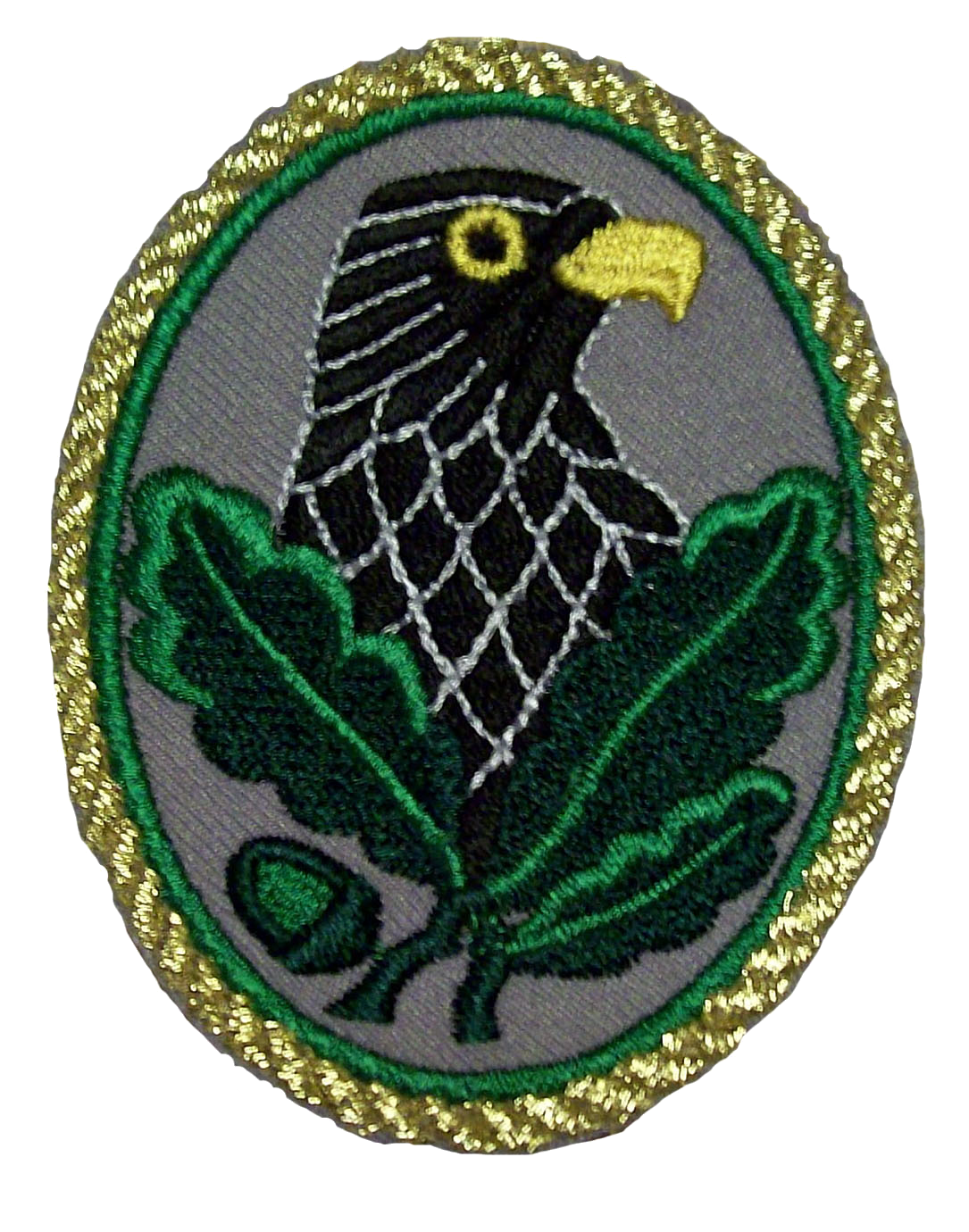
| Scharfschützen-Abzeichen | Sniper Badge | Indicates recognised sniper achievement, introduced late in the war |
In many documents the evidence is indirect. A Soldbuch might list equipment or awards, while a Wehrpass might record a training course or weapons qualification. Sometimes the most important clue is not a single word, but a combination of entries.
The sniper’s role
German snipers were used primarily within infantry, grenadier, Jäger, Gebirgsjäger, Fallschirmjäger and Waffen-SS formations. Their tasks included:
- observing enemy positions;
- eliminating enemy officers, observers, machine-gunners and other key personnel;
- disrupting movement in exposed areas;
- supporting defensive positions;
- countering enemy snipers;
- creating psychological pressure on opposing troops.
The sniper’s role became especially important on the Eastern Front, where large battlefields, ruined urban areas, forests, villages and extended defensive lines created many opportunities for concealed marksmen. By the later stages of the war, as German forces increasingly fought defensive battles, snipers were valued for their ability to slow enemy advances and make movement costly.
Weapons and equipment
The standard German sniper was usually armed with a service rifle fitted with a telescopic sight. The most common base weapon was the Karabiner 98k, though other rifles and captured weapons could also appear. Later in the war, semi-automatic rifles such as the Gewehr 43 could also be fitted with optics.
Typical sniper-related weapons and equipment included:
| Item | Notes |
|---|---|
| Karabiner 98k with scope | The classic German sniper rifle of the war |
| Gewehr 43 with scope | Semi-automatic rifle increasingly seen later in the war |
| ZF41 sight | A small, forward-mounted optical sight; more limited than larger sniper optics |
| ZF39 / Zielvier-type scopes | More conventional telescopic sights used on selected rifles |
| Camouflage clothing | Often improvised or issued depending on unit and front |
| Binoculars | Important for observation, though not always listed in personal documents |
In documentary research, the phrase Zielfernrohrgewehr is particularly important. It usually indicates that the soldier had at least some training or familiarisation with a scoped rifle. It should not automatically be interpreted as proof that the man was a fully trained and operational sniper, but it is one of the strongest clues available in many Wehrpässe.
Training
Sniper training varied according to period, unit and front. Early in the war, many skilled marksmen were selected within their units. Later, as the need for trained snipers became more formalised, soldiers could attend specific courses or receive more structured instruction.
Training could include:
- judging distance;
- selecting and camouflaging firing positions;
- fieldcraft and concealment;
- observation and reporting;
- use and maintenance of optical sights;
- firing from concealed or improvised positions;
- target selection;
- counter-sniper methods.
A Wehrpass may record this under general weapons training, specialist courses, or later annotations. A Soldbuch may contain supporting evidence through equipment, awards, identity photographs or unit stamps.
The Sniper Badge
The Scharfschützenabzeichen was introduced in 1944 as a special badge for snipers. It was awarded in grades according to the number of confirmed enemy kills. Because it was introduced late in the war, many earlier snipers never received it, even if they had served in the role.
The badge is therefore important, but its absence does not prove that a soldier was not a sniper. For many document groups, sniper identification must rely on training entries, unit history, combat context and surviving certificates rather than the badge alone.
Snipers in Wehrpässe and Soldbücher
For this website, the most important question is how sniper service appears in surviving personal documents. The answer is: inconsistently. Some Wehrpässe and Soldbücher clearly identify the man as a sniper, while others only preserve fragments of evidence.
Useful places to check include:
| Document section | What to look for |
|---|---|
| Weapons training | Entries such as Zielfernrohrgewehr, scoped-rifle training, or special shooting instruction |
| Courses and schools | References to sniper courses or specialist infantry schools |
| Unit postings | Service in infantry, grenadier, Jäger, Gebirgsjäger, Fallschirmjäger or reconnaissance units |
| Awards | Sniper Badge, Infantry Assault Badge, Iron Cross, Close Combat Clasp, or unit-level shooting awards |
| Combat record | Defensive fighting, urban combat, forest fighting or Eastern Front sectors where snipers were heavily used |
| Loose papers | Certificates, letters, training slips, award documents or postwar collector notes |
Researchers should be careful not to overstate the evidence. A soldier trained on a scoped rifle was not necessarily a front-line sniper. Conversely, a soldier may have served as a sniper without the role being written plainly in the surviving documents.
Common document clues
The following entries are especially relevant when studying possible sniper document groups:
- “Zielfernrohrgewehr” in the weapons-training section;
- “Scharfschütze” in rank, duty, course or award context;
- sniper-course stamps or school entries;
- references to Scharfschützenabzeichen;
- photographs showing a scoped rifle;
- possession of sniper-related award documents;
- unit history showing known sniper deployment;
- combat entries from sectors such as the Eastern Front, Italy, Normandy, or defensive battles in 1944–1945.
The strongest cases are those where several clues support each other. For example, a Wehrpass with a scoped-rifle training entry, a sniper-course notation, front-line infantry service and a Sniper Badge entry would be much stronger evidence than a single isolated weapons entry.
Historical context
Snipers were used by all major armies during the Second World War, but their importance rose and fell according to tactical circumstances. In the German Army, sniping became particularly prominent during the long defensive phase of the war. As the Wehrmacht lost the initiative, small groups of well-trained marksmen became useful in slowing enemy movement, defending strongpoints and increasing the cost of enemy attacks.
On the Eastern Front, German snipers faced Soviet forces that placed considerable emphasis on sniping and produced some of the most famous snipers of the war. This encouraged the German Army to give greater attention to sniper training, equipment and recognition. By 1944, the introduction of the Sniper Badge reflected this increased institutional recognition.
Research caution
Because sniper-related documents are desirable to collectors, they should be examined critically. Added inscriptions, postwar notes, mismatched photographs or unsupported claims can all distort the history of a document group. Whenever possible, the following should be checked:
- consistency of handwriting and ink;
- whether the unit stamps match the period and posting;
- whether the dates of training, awards and unit service make sense;
- whether the man’s unit was in a sector where the claimed combat took place;
- whether loose certificates belong to the same soldier;
- whether photographs can be securely connected to the document group.
A careful reconstruction should distinguish between confirmed, probable and possible sniper service.
Conclusion
German sniper documents offer a fascinating window into a specialised part of Wehrmacht infantry service. They show not only the technical side of scoped rifles and marksmanship, but also the personal path of individual soldiers through training, front-line service, awards and, in many cases, death or disappearance.
For the study of Wehrpässe and Soldbücher, these documents are valuable precisely because they require close reading. A single word such as Scharfschütze may be decisive, but often the story must be reconstructed from several small clues: a weapons entry, a course stamp, a unit posting, an award date, or a photograph. When interpreted carefully, such records can preserve the life and military career of men who otherwise appear only as names in wartime paperwork.