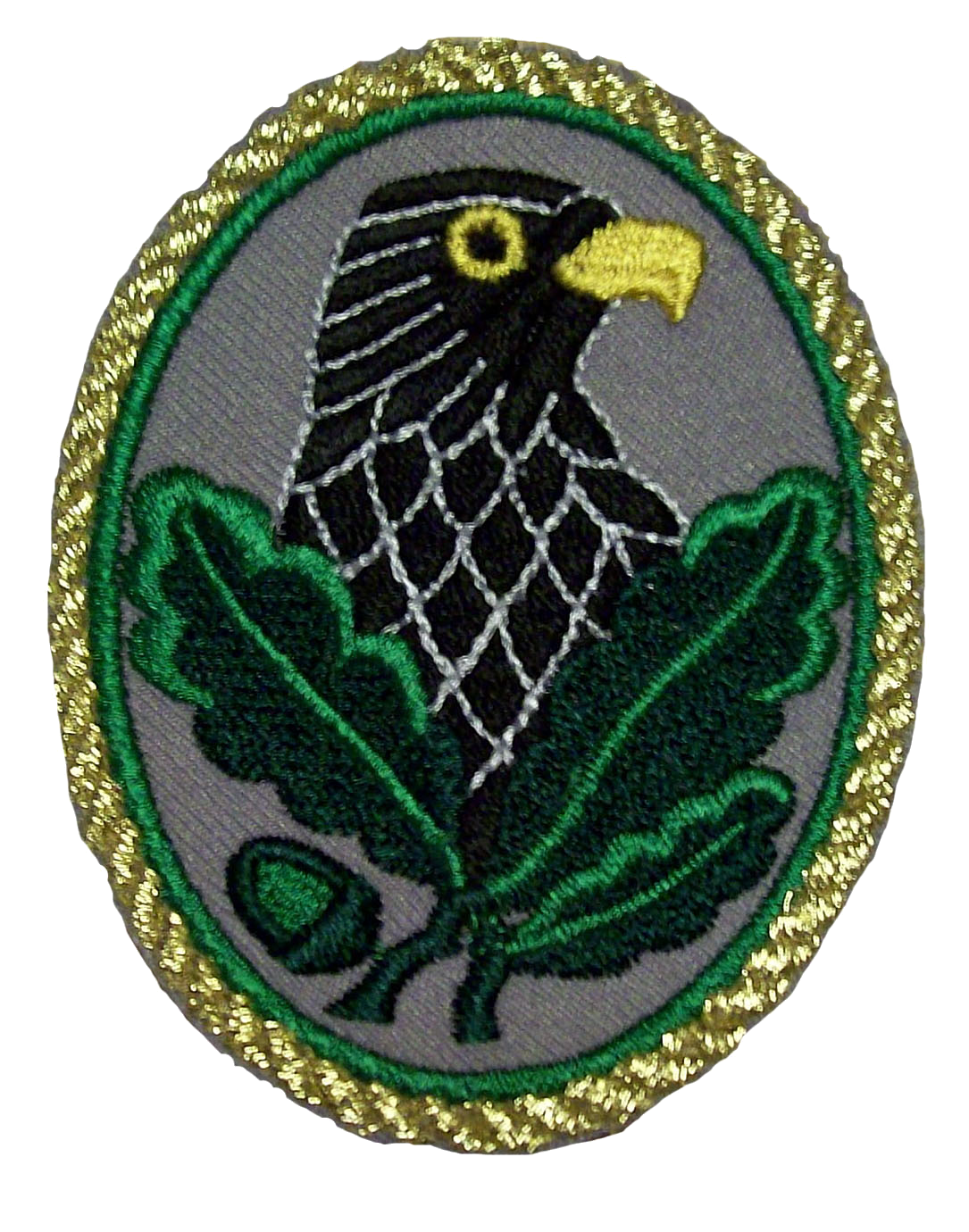
Zielfernrohrgewehr
A Zielfernrohrgewehr was a rifle fitted with a telescopic sight. In the context of the German armed forces during the Second World War, the term is especially important because it often appears in Wehrpässe, Soldbücher, training records, and weapons qualification pages connected with possible or confirmed sniper service.
The word is a compound of three German terms: Ziel meaning target, Fernrohr meaning telescope or optical sight, and Gewehr meaning rifle. Literally, a Zielfernrohrgewehr is therefore a “telescopic-sight rifle” or “scoped rifle”. In English-language collector and research circles it is often understood as a sniper rifle, although the exact meaning in a document should always be interpreted carefully.
Meaning of the term
In German military paperwork, Zielfernrohrgewehr usually indicates that a soldier was trained on, issued, or familiar with a rifle equipped with an optical sight. It does not always prove that the soldier served operationally as a sniper. However, it is one of the strongest documentary clues when studying possible German sniper-related Wehrpässe and Soldbücher.
A typical weapons-training entry might list ordinary infantry weapons such as the Karabiner 98k, MG 34, MG 42, hand grenades, pistol, submachine gun, and then include the word Zielfernrohrgewehr. In such a case, the entry shows that scoped-rifle training formed part of the man’s recorded military instruction.
Relationship to German snipers
The German word most directly associated with a sniper is Scharfschütze. A Scharfschütze could be equipped with a Zielfernrohrgewehr, but the two terms are not identical.
| Term | Literal meaning | Research significance |
|---|---|---|
| Scharfschütze | Sharpshooter / sniper | Indicates a role, status, or specialist function |
| Zielfernrohrgewehr | Scoped rifle | Indicates a weapon or weapons-training category |
| Zielfernrohrschütze | Scoped-rifle shooter | Sometimes used for a soldier trained or employed with a scoped rifle |
| Scharfschützen-Lehrgang | Sniper course | Strong evidence for formal sniper training |
For document research, the distinction matters. A man whose Wehrpass lists Zielfernrohrgewehr was not necessarily a confirmed sniper. He may have been trained on the weapon as part of infantry instruction, selected for possible use as a marksman, or recorded as having completed a specific weapons qualification. Stronger evidence is present when the same document group also includes a sniper course, a unit role, a photograph with a scoped rifle, a sniper badge entry, or repeated references to Scharfschütze.
Scoped rifles in German service
The most common German basis for a scoped rifle was the Karabiner 98k, the standard bolt-action service rifle of the Wehrmacht. Selected rifles were fitted with optical sights and used by trained marksmen and snipers.
Later in the war, semi-automatic rifles such as the Gewehr 43 could also be fitted with scopes. These weapons offered faster follow-up shots than a bolt-action rifle, although availability and quality varied. In practice, German snipers and scoped-rifle shooters used a variety of equipment depending on period, unit, front, and supply situation.
Commonly encountered sniper-related weapons and optics include:
| Weapon or optic | Notes |
|---|---|
| Karabiner 98k with scope | The classic German scoped rifle of the war |
| Gewehr 43 with scope | Semi-automatic scoped rifle, more common later in the war |
| ZF41 | Small low-power optical sight, often mounted forward on the rifle |
| ZF39 / Zielvier-type scopes | More conventional telescopic sights used on selected rifles |
| Captured scoped rifles | Occasionally encountered, especially on the Eastern Front |
The presence of a scoped rifle did not make every soldier a sniper in the formal sense. German units could use skilled riflemen, designated marksmen, observers, and snipers in overlapping ways, and wartime paperwork does not always preserve the difference clearly.
Appearance in the Wehrpass
The Wehrpass is often the most important source for identifying Zielfernrohrgewehr training. The entry is usually found in the section dealing with Ausbildung or weapons instruction. Depending on the individual booklet, the term may appear among a list of weapons on which the soldier was trained.
A relevant entry may appear alongside weapons such as:
- Gewehr 98 or Karabiner 98k;
- MG 34;
- MG 42;
- le.Gr.W. 36;
- m.Gr.W. 34;
- Pistole 08;
- Maschinenpistole 38 or 40;
- Schießbecher;
- Hand grenades;
- Zielfernrohrgewehr.
For researchers, this entry should be copied exactly as written. The spelling, date, unit stamp, and signature can all be important. Some entries may use abbreviations or variant wording, and handwriting can easily be misread.
Appearance in the Soldbuch
The Soldbuch was carried by the soldier and often contains more practical service information than the Wehrpass. A Soldbuch may provide evidence connected to scoped-rifle service through equipment issue, unit stamps, award entries, identity photographs, or inserted notes.
However, the Soldbuch does not always list every weapon on which the soldier was trained. Therefore, absence of the word Zielfernrohrgewehr in a Soldbuch does not prove that the soldier was not trained as a sniper or scoped-rifle shooter.
Possible Soldbuch clues include:
- unit assignment to infantry, Jäger, Gebirgsjäger, Fallschirmjäger, reconnaissance, or similar formations;
- entries connected with specialist courses;
- award entries for the Scharfschützenabzeichen;
- photographs showing a scoped rifle;
- equipment or issue notes;
- field-unit stamps connected with known sniper use.
Training and selection
German soldiers selected for scoped-rifle use were usually expected to show strong marksmanship, patience, fieldcraft, and discipline. Training could vary widely. Some men received formal sniper instruction, while others were selected within their units because they were good shots.
Training might include:
- judging distance;
- selecting firing positions;
- camouflage and concealment;
- observation of enemy movement;
- careful use of terrain;
- maintaining and zeroing the optical sight;
- firing from supported and improvised positions;
- target selection;
- counter-sniper awareness.
A formal Scharfschützen-Lehrgang is stronger evidence than a simple weapons list. Nevertheless, a weapons-training entry for Zielfernrohrgewehr remains significant, especially when combined with front-line infantry service and combat in sectors where snipers were heavily used.
The Zielfernrohrgewehr as a document clue
For Scharfschütze-related research, the term Zielfernrohrgewehr should be treated as an important clue rather than automatic proof.
| Evidence level | Example | Interpretation |
|---|---|---|
| Strong | Scharfschütze written in the document, sniper course, sniper badge, and scoped-rifle training | Very likely confirmed sniper service |
| Moderate | Zielfernrohrgewehr training plus front-line infantry service and relevant combat record | Possible or probable scoped-rifle role |
| Limited | Zielfernrohrgewehr listed once among many weapons | Shows training or familiarisation, but not necessarily operational sniper service |
| Weak | Collector description only, with no document entry | Requires caution and further evidence |
The best research approach is to build a full picture from all available documents. A single word can be important, but it should be considered alongside dates, units, courses, awards, photographs, and combat history.
Common mistakes in interpretation
Collectors and researchers should avoid several common mistakes.
First, Zielfernrohrgewehr should not automatically be translated as “sniper” without qualification. It refers to the weapon, not necessarily the soldier’s role.
Second, a man trained on a scoped rifle may have been intended for sniper duties but not necessarily used in that capacity at the front.
Third, not every confirmed sniper will have a clear Scharfschütze entry. Wartime paperwork was inconsistent, especially in the later years of the war.
Fourth, loose notes and postwar collector descriptions should not be treated as equal to wartime entries. Whenever possible, the original Wehrpass or Soldbuch entry should be examined.
Research checklist
When a Wehrpass or Soldbuch contains the term Zielfernrohrgewehr, the following questions are useful:
- Where exactly does the entry appear?
- Is it in the weapons-training section, a course section, an equipment list, or a later note?
- Is the entry dated?
- Which unit or training formation signed or stamped it?
- Does the soldier later serve in a front-line infantry unit?
- Are there entries for sniper courses or infantry schools?
- Are there awards such as the Scharfschützenabzeichen, Iron Cross, Infantry Assault Badge, or Close Combat Clasp?
- Do photographs show a scoped rifle?
- Does the combat record match known sniper-heavy sectors or defensive fighting?
- Is there any evidence that the entry was added later?
Example wording for article descriptions
When describing a document group, it is often best to use careful wording such as:
- The Wehrpass records training with the Zielfernrohrgewehr, indicating that the soldier received instruction with a scoped rifle. This is an important sniper-related clue, although it does not by itself prove operational service as a Scharfschütze.
Or, when additional evidence exists:
- Together with the sniper-course entry and later front-line service, the Zielfernrohrgewehr entry supports the identification of this soldier as a probable Scharfschütze.
Such wording keeps the article accurate while still recognising the importance of the entry.
Conclusion
The Zielfernrohrgewehr is one of the key terms for anyone studying German sniper-related Wehrpässe and Soldbücher. It points to the use or training of a rifle fitted with an optical sight and may be a significant clue in identifying a sniper, sharpshooter, or scoped-rifle specialist.
At the same time, the term must be handled carefully. A scoped rifle is not the same thing as a confirmed sniper role. The strongest identifications come from a combination of evidence: weapons training, specialist courses, unit context, award entries, photographs, and combat history.
For this reason, Zielfernrohrgewehr entries are among the most interesting details in German military documents. They often provide the first thread from which a wider story of training, front-line service, and possible sniper activity can be reconstructed.