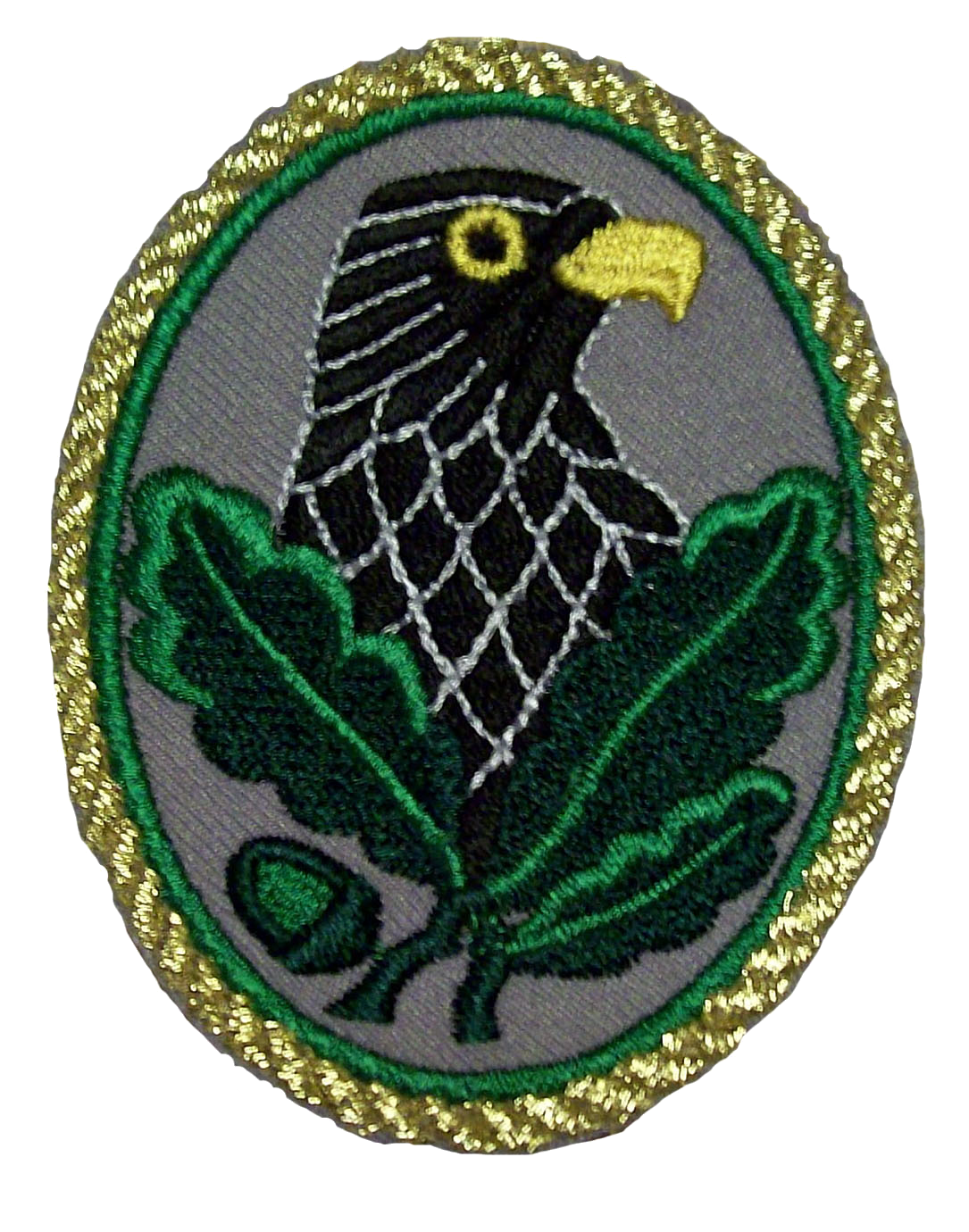
Scharfschützenabzeichen
The Scharfschützenabzeichen — or Sniper Badge — was a German Second World War cloth badge awarded to snipers for confirmed successes in combat. It was introduced late in the war, on 20 August 1944, and therefore appears only in a relatively small number of surviving wartime documents.
For researchers of Wehrpässe and Soldbücher, the Scharfschützenabzeichen is one of the clearest indications that a soldier was recognised as a sniper. However, its absence does not prove that a man was not a sniper, because the award was created only in the final phase of the war.
Overview
The badge was awarded in three grades according to the number of confirmed enemy soldiers killed by the sniper. These were counted only from 1 September 1944 onward. Earlier sniper successes did not normally count toward the official award total.
| Grade | Requirement | Appearance |
|---|---|---|
| 3rd Class | 20 confirmed sniper kills | Badge without surrounding cord |
| 2nd Class | 40 confirmed sniper kills | Badge with silver-coloured cord |
| 1st Class | 60 confirmed sniper kills | Badge with gold-coloured cord |
The three-grade system makes the Scharfschützenabzeichen especially useful for document research. If a Wehrpass or Soldbuch records the grade, it may also indicate the minimum number of confirmed sniper successes officially credited to the soldier.
Design
The Scharfschützenabzeichen was a cloth sleeve badge. It was normally oval in shape and showed the head of an eagle, with oak leaves and an acorn beneath or around the design. The badge was embroidered on a greenish or field-grey cloth background.
The difference between the grades was shown by the border:
| Grade | Border | Interpretation |
|---|---|---|
| 3rd Class | No cord | Award for 20 confirmed kills |
| 2nd Class | Silver cord | Award for 40 confirmed kills |
| 1st Class | Gold cord | Award for 60 confirmed kills |
Because the badge was made of cloth, surviving examples may show considerable variation in colour, wear, backing material, and embroidery quality. Late-war production conditions also contributed to differences between examples.
3rd Class Scharfschützenabzeichen
The 3rd Class was the lowest grade of the badge and was awarded for 20 confirmed sniper kills.
It had the same central design as the higher grades, but without the silver or gold cord around the edge. In document descriptions, it may be referred to simply as the Scharfschützenabzeichen without further qualification. This can create uncertainty, because not every entry clearly states the grade.
For researchers, a 3rd Class award is still highly significant. It indicates that the soldier was not merely trained with a scoped rifle, but was officially credited with confirmed sniper successes.
2nd Class Scharfschützenabzeichen
The 2nd Class was awarded for 40 confirmed sniper kills.
It was distinguished by a silver-coloured cord around the edge of the badge. This grade indicates a higher level of officially recognised sniper activity. In a Wehrpass or Soldbuch, it may be described as:
- Scharfschützenabzeichen 2. Klasse;
- Scharfschützenabz. II. Klasse;
- Scharfschützenabzeichen in Silber;
- or by similar abbreviated wording.
Because the badge was introduced so late in the war, 2nd Class awards are comparatively uncommon in surviving documents.
1st Class Scharfschützenabzeichen
The 1st Class was the highest grade and was awarded for 60 confirmed sniper kills.
It was distinguished by a gold-coloured cord around the edge. A documented 1st Class Scharfschützenabzeichen is an especially strong indication of a highly active sniper in late-war service.
In document entries, this grade may appear as:
- Scharfschützenabzeichen 1. Klasse;
- Scharfschützenabz. I. Klasse;
- Scharfschützenabzeichen in Gold;
- or a similar abbreviated form.
Because the counting period began only on 1 September 1944, reaching the 1st Class threshold required a high number of confirmed sniper kills in a very short and chaotic period of the war.
Confirmation of sniper kills
The badge was not intended to be awarded simply on a soldier’s personal claim. Enemy kills had to be confirmed and reported through the unit. Close-combat kills were not counted toward the sniper total. The award therefore depended on administrative confirmation as well as battlefield performance.
For document research, this is important. A soldier might have served as a sniper, or even have been regarded as one within his unit, without necessarily receiving the badge. Conversely, a recorded Scharfschützenabzeichen is one of the strongest pieces of evidence that the soldier’s sniper role was officially recognised.
Wearing of the badge
The Scharfschützenabzeichen was worn on the uniform sleeve. Period descriptions usually place it on the lower right sleeve. Because it was a cloth badge, it was sewn onto the tunic rather than pinned like a metal decoration.
In photographs, the badge may be difficult to see because of pose, lighting, tunic wear, or the fact that many soldiers were photographed before receiving it. A portrait photograph without the badge does not prove that the soldier never received it.
Appearance in Wehrpässe and Soldbücher
In a Wehrpass, the Scharfschützenabzeichen may appear in the section for awards and decorations. In a Soldbuch, it may appear among award entries, sometimes with a date, unit stamp, or signature.
Researchers should look for wording such as:
- Scharfschützenabzeichen;
- Scharfschützen-Abz.;
- Scharfschützenabz. 1. Klasse;
- Scharfschützenabz. 2. Klasse;
- Scharfschützenabz. 3. Klasse;
- Scharfschützenabzeichen in Silber;
- Scharfschützenabzeichen in Gold.
Entries may be abbreviated, handwritten, or partly obscured. In some cases the grade may not be written clearly. The date of the award is important, because the badge did not exist before August 1944.
Relationship to the Zielfernrohrgewehr
The Scharfschützenabzeichen should be distinguished from entries relating to the Zielfernrohrgewehr, or scoped rifle. A Wehrpass may record training with a scoped rifle without proving that the man became an operational sniper. The Scharfschützenabzeichen, by contrast, indicates officially recognised sniper achievement.
| Evidence | Meaning | Strength as sniper evidence |
|---|---|---|
| Zielfernrohrgewehr | Training with or use of a scoped rifle | Important clue, but not proof by itself |
| Scharfschützen-Lehrgang | Formal sniper course | Strong evidence for sniper training |
| Scharfschützenabzeichen | Award for confirmed sniper kills | Very strong evidence of recognised sniper service |
The strongest document groups are those where these clues appear together: scoped-rifle training, sniper-course entries, front-line infantry service, and the award of the Scharfschützenabzeichen.
Research value
For collectors and historians, the Scharfschützenabzeichen is important because it can turn a possible sniper document group into a confirmed or near-confirmed one. However, the badge should still be studied in context.
Important questions include:
- Is the award entered in the Wehrpass or Soldbuch?
- Is the grade clearly written?
- Is there a date of award?
- Which unit confirmed or entered the award?
- Does the soldier’s unit and combat record match the date?
- Are there supporting entries for scoped-rifle training or sniper courses?
- Are there photographs, award documents, or field letters connected with the badge?
- Does the handwriting and ink match other period entries?
Because sniper-related items are desirable to collectors, postwar additions and mismatched document groups must be treated with caution.
Common interpretation problems
Several problems occur frequently when studying Scharfschützenabzeichen entries.
First, the grade is not always clear. A document might simply say Scharfschützenabzeichen without stating 1st, 2nd, or 3rd Class.
Second, the badge was introduced very late. A soldier who was killed or captured before autumn 1944 could not have received it, even if he had served as a sniper.
Third, surviving photographs may not show the badge. This may be because the photograph was taken earlier, because the badge was worn on a sleeve not visible in the picture, or because it was not sewn on for the photograph.
Fourth, collector descriptions sometimes use “sniper badge” loosely. The original document entry is more important than a modern sales description.
Conclusion
The Scharfschützenabzeichen was the most specific German award connected with sniper service in the Second World War. Its three grades — for 20, 40, and 60 confirmed sniper kills — make it one of the most important clues in Wehrpass and Soldbuch research.
Because the badge was introduced only in August 1944, it belongs to the final phase of the war. This late introduction makes genuine documented examples relatively scarce and historically valuable. When found in a Wehrpass, Soldbuch, award certificate, or photograph, it should be examined carefully and interpreted together with the soldier’s training, unit postings, combat record, and other awards.
For Scharfschütze research, the badge represents more than a decoration. It is a direct administrative trace of a soldier whose role as a sniper was officially recognised by the German military.