Wehrpass:Otto Körner
Hans-Otto Körner (22 July 1923 – 23 June 1944) was a young German Army officer of the Second World War. His surviving document group, including a Wehrpass, Hitler Youth papers, photographs and a death notice, allows a partial reconstruction of his short life and military career. By the time of his death in June 1944 he had reached the rank of Leutnant der Reserve and appears to have served with elements of Füsilier-Regiment 34 in the Narva sector on the Eastern Front.
He was killed on 23 June 1944, at the age of only twenty, during the fighting near Narva. His death notice describes him as having fallen “an der Spitze seiner Soldaten” — at the head of his soldiers — and states that he died while attempting to assist his wounded brother.
Basic details
| Field | Information |
|---|---|
| Full name | Hans-Otto Körner; the Wehrpass also gives the forenames as Bruno Hans-Otto |
| Date of birth | 22 July 1923 |
| Place of birth | Zschopau, Saxony |
| Residence / administrative district | Chemnitz area |
| Nationality | Deutsches Reich |
| Religion | Evangelical-Lutheran |
| Marital status | Single |
| Civilian occupation | Student / pupil |
| Father | Otto Körner, described as a Studienrat |
| Mother | Margarethe Körner, née Stallmann |
| Final rank | Leutnant der Reserve |
| Date of death | 23 June 1944 |
| Place of death | Near Narva, Eastern Front |
Family background
The death notice shows that Hans-Otto Körner came from an educated middle-class family in Saxony. His father, Otto Körner, is described as a Studienrat, a secondary-school teacher or senior teacher. His mother was Margarethe Körner, née Stallmann.
The same notice names several close relatives, including:
- Kapitänleutnant Reinhold Körner, apparently a naval officer;
- Stabsgefreiter Hermann Körner;
- Gefreiter Wolfgang Körner.
This suggests that several members of the Körner family were serving in the German armed forces during the war.
Youth and education
Körner’s Wehrpass records his education as Staatsgymnasium, indicating that he had attended an academically oriented secondary school. His foreign-language knowledge is recorded as including Latin and English.
A surviving Hitler Youth identity document shows that he had also been a member of the Hitlerjugend. The document bears his photograph and identifies him as Hans-Otto Körner of the Chemnitz area. A separate letter dated 8 April 1941 refers to his Hitler Youth service and appears to concern the wearing or entitlement of a specific Hitler Youth badge or distinction. The exact administrative wording is partly difficult to read, but the document places Körner within the pre-military youth structures of the period.
Musterung and military fitness
Körner was examined by the Wehrbezirkskommando Chemnitz II on 16 June 1941. His Wehrpass classifies him as a Dienstpflichtiger, meaning a man liable for military service.
The military fitness section records him as suitable for service. A later pasted note dated 9 May 1942 states that he was examined during a service-eligibility inspection and found suitable as a Gas-Spritzer or related gas-protection role. The exact phrase is partly difficult to read, but it appears to concern anti-gas or decontamination duties.
Military service
The Wehrpass provides a sequence of postings, mostly connected with replacement and training units before Körner was sent to the front. Several entries are partly obscured or difficult to read, but the following outline can be reconstructed.
| Date | Unit / posting | Notes |
|---|---|---|
| 2 March 1942 | 4. (M.G.) / Infanterie-Ersatz-Bataillon 513 | Machine-gun company of Infantry Replacement Battalion 513 |
| 1942 | Stabskompanie / Infanterie-Ersatz-Bataillon 513 | Reading partly uncertain |
| 1942 | 9. Kompanie / Regiment 513 | Reading partly uncertain |
| 1943 | Grenadier-Ersatz-Bataillon 513 | Replacement and training service |
| 1943 | Nachrichten-Kompanie / Grenadier-Ersatz-Regiment 513 | Signals company; reading partly uncertain |
| 1943 | Stamm-Kompanie / Grenadier-Ersatz-Bataillon 513 | Depot / permanent cadre company |
| 1944 | Führerreserve Heeresgruppe Mitte | Officer reserve attached to Army Group Centre |
| From April 1944 | II. Bataillon / Füsilier-Regiment 34 | Front-line posting; final active unit |
The unit entries show the path of a young educated recruit who was selected for advancement. He began in replacement and training formations, passed through officer-candidate stages, and ultimately reached front-line service as a reserve officer.
Training
The Wehrpass contains a weapons-training entry listing a broad range of infantry weapons. These include:
- Gewehr 98;
- MG 34;
- MG 42;
- le.Gr.W. 36, the light 5 cm mortar;
- m.Gr.W., probably the 8 cm medium mortar;
- Mehrladegewehr;
- Zielfernrohrgewehr, a telescopic-sight rifle;
- Schießbecher, the rifle grenade launcher;
- Stielhandgranate and Eierhandgranate;
- Pistole 08 / 38;
- Maschinenpistole 38.
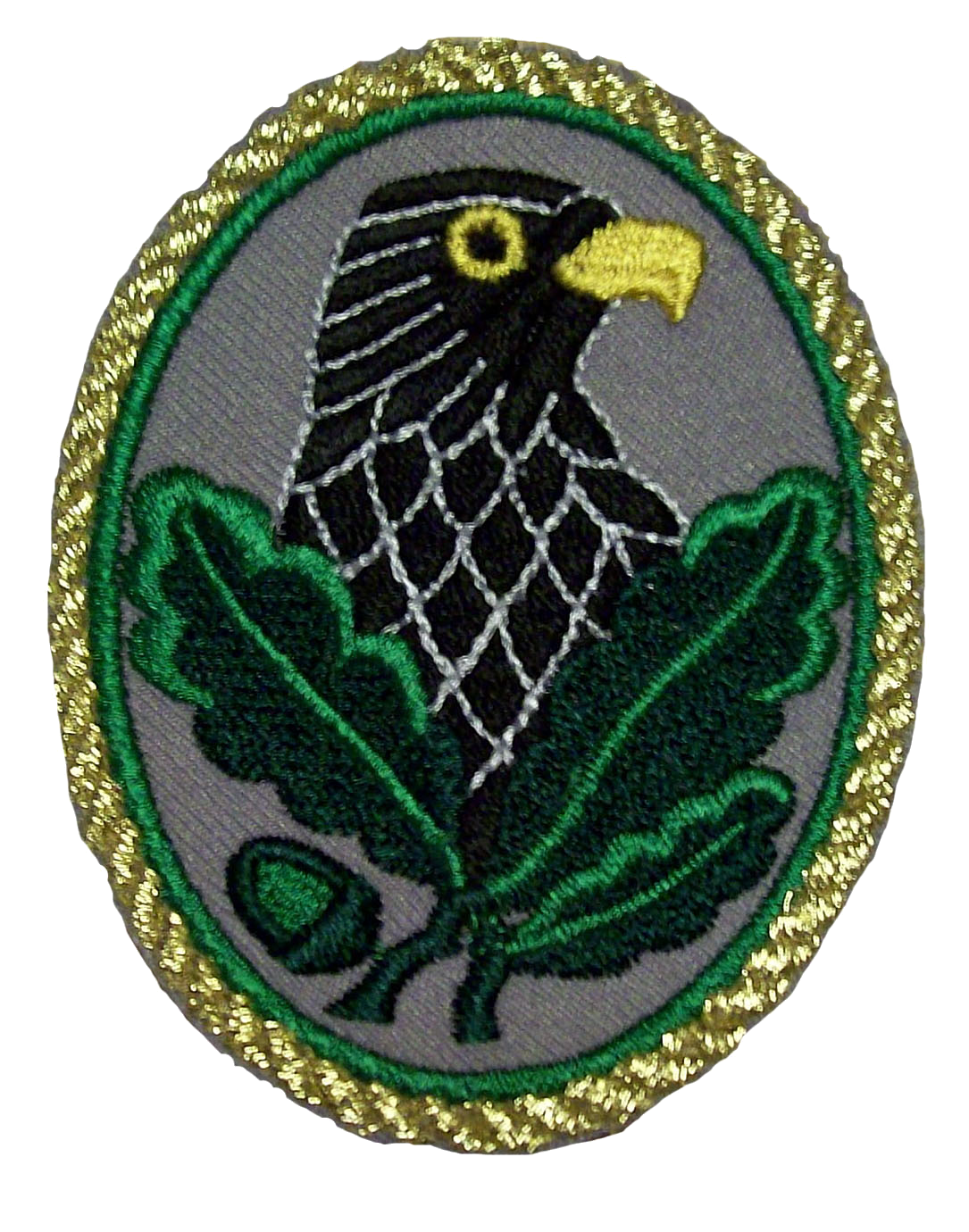
The inclusion of Zielfernrohrgewehr is notable. It indicates familiarisation with scoped rifles, although it does not by itself prove that Körner served operationally as a sniper.
Another entry shows that he attended the Schule V für Fahnenjunker der Infanterie at Potsdam from 6 August 1943 to 23 November 1943. This was an officer-candidate course. The entry confirms that Körner was being trained for commissioned leadership rather than remaining in the enlisted or non-commissioned ranks.
Promotions
The promotion page records Körner’s rapid wartime advancement.
| Date | Rank / appointment | Notes |
|---|---|---|
| 1 September 1942 | Gefreiter | First enlisted promotion |
| 1 August 1943 | Unteroffizier der Reserve, possibly officer-candidate status | Reading partly uncertain |
| 1 October 1943 | Fahnenjunker-Feldwebel der Reserve | Officer-candidate Feldwebel rank |
| 1 November 1943 | Oberfähnrich der Reserve | Senior officer-candidate rank |
| 1 December 1943 | Leutnant der Reserve | Commissioned officer |
This sequence shows that Körner was selected for the officer track during 1943. His promotion to Leutnant der Reserve came only a few months before his death.
Awards and decorations
The document group and Wehrpass entries indicate that Körner received at least the following awards:
| Award | Date | Notes |
|---|---|---|
| Eisernes Kreuz II. Klasse | 16 June 1944 | Awarded shortly before his death |
| Infanterie-Sturmabzeichen | Date uncertain | The exact class or wording is difficult to read from the image |
The award of the Iron Cross 2nd Class on 16 June 1944 is especially poignant, as Körner was killed only one week later.
Front-line service near Narva
The combat section of the Wehrpass records Körner’s participation in the fighting in the Narva area in 1944. The entries appear to describe:
- Stellungskämpfe between February and June 1944 in the Narva sector;
- Abwehrkämpfe around 20 June 1944, also in the Narva sector.
The death notice states that he fell near Narwa on 23 June 1944. The Narva front was one of the most fiercely contested sectors of the Eastern Front in 1944, as German forces attempted to hold Estonia against Soviet offensives. Körner’s final unit, II. Bataillon / Füsilier-Regiment 34, was therefore involved in defensive combat during a period of intense pressure.
Death
Hans-Otto Körner was killed on 23 June 1944. The casualty entry in the Wehrpass records him as gefallen. The exact place-name written in the Wehrpass is difficult to read, but the accompanying death notice places his death near Narwa.
The family death notice gives a more personal account. It states that Körner fell shortly before his twenty-first birthday while leading his soldiers and while trying to assist his wounded brother. The notice describes his death in the language typical of wartime German memorial cards: solemn, patriotic, and family-centred.
His death was announced from Adelsberg bei Chemnitz in August 1944.
Document group
The surviving group includes:
- a portrait photograph of Körner in uniform;
- his Wehrpass;
- a Hitler Youth identity document;
- a Hitler Youth-related letter dated 8 April 1941;
- a death notice or memorial card;
- associated loose inserts and stamps.
Together these documents form a compact but unusually informative record of a young officer’s path from schoolboy and Hitler Youth member to infantry officer on the Eastern Front.
Historical significance
Hans-Otto Körner’s documents illustrate the accelerated wartime career of a young German officer candidate. Born in 1923, he belonged to the generation that came of age entirely under the National Socialist regime. His papers show the typical sequence of youth organisation, conscription, training, officer-candidate schooling and eventual front-line deployment.
His career also demonstrates how quickly young men could be pushed into leadership roles during the later years of the war. Körner became a Leutnant der Reserve in December 1943 and was dead by June 1944. His Iron Cross was awarded only days before his death.
For collectors and researchers, the value of this document group lies not only in the individual biography, but also in the way the papers connect several aspects of wartime life: Hitler Youth service, Wehrmacht conscription, officer training, weapons instruction, front-line combat, awards, and family mourning.
Notes on transcription
Some entries in the Wehrpass are difficult to read. In particular, several unit entries, handwritten place-names, and some award details. The reconstruction above is therefore best understood as a careful reading of the visible material rather than a complete archival biography.